

Every January, founders set ambitious goals.
And every year, many of those goals quietly fall away under pressure, distraction, and day-to-day survival mode.
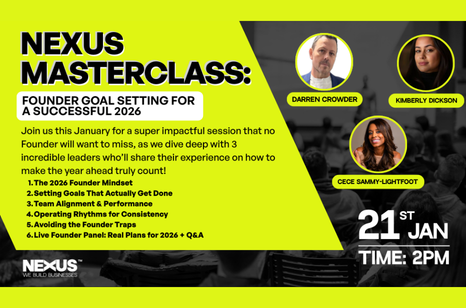
At our NEXUS Masterclass: Founder Goal Setting for a Successful 2026, we brought together three experienced leaders to have an honest, practical conversation about what actually works when planning the year ahead — and what founders consistently get wrong.
Rather than theory or hype, this session focused on real founder experience: building businesses through uncertainty, managing teams, protecting mental health, and creating momentum that lasts beyond Q1.
Meet the Speakers
We were joined by three leaders operating at the intersection of strategy, performance, leadership, and execution:
- Darren Crowder — Founder of Enbodie, working at the forefront of health, AI, and sustainable human performance
- Kimberly Dickson — Founder of HyperTribe, helping founders and creatives build scalable, defensible businesses
- CeCe Sammy-Lightfoot — International Vocal Coach, Consultant, Entrepreneur, and Champion of the Arts, supporting leaders to communicate with confidence and authority
Each speaker brought a different lens — but the same core message: successful goal setting starts with clarity, not pressure.
1. The 2026 Founder Mindset: Clarity Over Chaos
One of the strongest themes across the session was mindset.
Founders often begin the year with energy, ambition, and big plans — but without a clear framework, those plans can quickly turn into overwhelm. The speakers emphasised the importance of understanding the difference between:
- What you want long-term
- What you need right now to move forward
This distinction helps founders avoid setting goals based on comparison, trends, or external expectations — and instead focus on priorities that genuinely matter to their business stage.
2. Why Most Founder Goals Don’t Get Done
A recurring insight from the panel was that many founder goals fail not because they’re unrealistic, but because they’re too disconnected from execution.
Common traps include:
- Over-planning far into the future
- Obsessing over quarterly or annual goals instead of weekly progress
- Setting targets without clear ownership or metrics
Instead, the speakers highlighted the power of short feedback loops, weekly priorities, and tracking only the metrics that truly move the business forward.
For early-stage founders in particular, the message was clear:
👉 If you’re under a certain revenue threshold, almost everything comes back to sales and traction.
3. Traction, Revenue & What Investors Actually Care About
As the fundraising landscape continues to shift, the panel shared candid insights into what investors are really looking for in 2026.
While vision still matters, founders are increasingly expected to demonstrate:
- Clear proof points
- Evidence of execution
- A defensible strategy
- An understanding of their numbers
Several speakers noted that conversations have moved away from “who you’re talking to” and towards what you’ve actually signed, shipped, or validated.
Traction, even at a small scale, builds credibility — and reduces pressure when raising.
4. Team Alignment & Operating Rhythms
Goal setting doesn’t happen in isolation — especially once a team is involved.
The discussion explored how founders can:
- Keep teams aligned when plans change
- Build trust without rigid processes
- Balance structure with flexibility
Rather than relying on heavy planning cycles, the speakers shared approaches such as:
- Short stand-ups
- Clear individual ownership
- Frequent communication
- A shared understanding of direction, even when tactics shift
The takeaway? People don’t need certainty — they need clarity and trust.
5. Founder Mental Health: You Are Not Your Business
One of the most powerful moments of the session came when the conversation turned to mental health.
The speakers spoke openly about:
- Panic attacks
- Founder anxiety
- Pressure around money and performance
- The danger of tying identity too closely to the business
A key reminder for founders heading into 2026:
You are more than your startup.
Protecting mental wellbeing isn’t a “nice to have” — it directly impacts decision-making, leadership, and long-term success.
6. Final Advice for Founders Heading Into 2026
As the session closed, each speaker shared a simple but powerful piece of advice:
- Don’t be afraid to fail — failure is part of building
- Focus on what you can control this week
- Build defensibility before obsessing over competition
- Create support systems outside your business
- Keep perspective — this is a long game
Success in 2026 won’t come from doing more — but from doing the right things, consistently.
Watch the Full Masterclass
If you’re a founder looking to approach 2026 with more intention, clarity, and confidence, the full session is now available to watch on demand.
👉 Watch the webinar on YouTube
👉 Explore more founder resources via NEXUS
About NEXUS
NEXUS is a founder community and business-building platform supporting entrepreneurs through education, connection, and practical support.
We build businesses — together.